PHP2Shell in October, Java4Shell on 17 November, Nginx2Shell on 18 November: the third critical flaw in a few weeks does not hit an application server this time, but the component in front of it. For many file platforms, webmails and Kubernetes clusters, NGINX is the front door: it accepts every connection, terminates TLS and forwards the request.
This article explains what the flaw means, what a compromised proxy can see, and what it cannot see when the keys live elsewhere.
What is known
Nginx2Shell combines two bugs in NGINX's HTTP/2 module [1][2]:
- CVE-2026-123007, memory corruption in HTTP/2 flow control. It affects NGINX Open Source 1.9.5 to 1.31.8 whenever HTTP/2 is enabled, even when NGINX only serves static files over HTTPS. A public proof of concept is available.
- CVE-2026-123633, a use-after-free in HTTP/2 connection handling, affecting 1.19.7 to 1.31.8 when NGINX proxies to an application.
According to the researchers, both allow code execution without authentication; CVSS 4.0 is 9.2 for each. Fixes are in NGINX 1.30.7 and 1.31.9 of 18 November 2026. No confirmed attacks were known at the time of disclosure [1].
One point deserves attention: products that bundle NGINX stay affected until they ship an update themselves. The widely used Kubernetes ingress controller kubernetes/ingress-nginx is archived and will not receive a fix [1].
Why the reverse proxy is special
An attacker on the file server sees what is stored on the server. An attacker on the reverse proxy sees what passes through it, after TLS has been decrypted:
- every user's logins and session cookies,
- files being uploaded and downloaded,
- emails being read in the webmail,
- the content of documents being edited in the browser.
And it sits in front of every application at once: Nextcloud, OpenCloud, webmail, Collabora and often the identity provider run behind the same proxy.
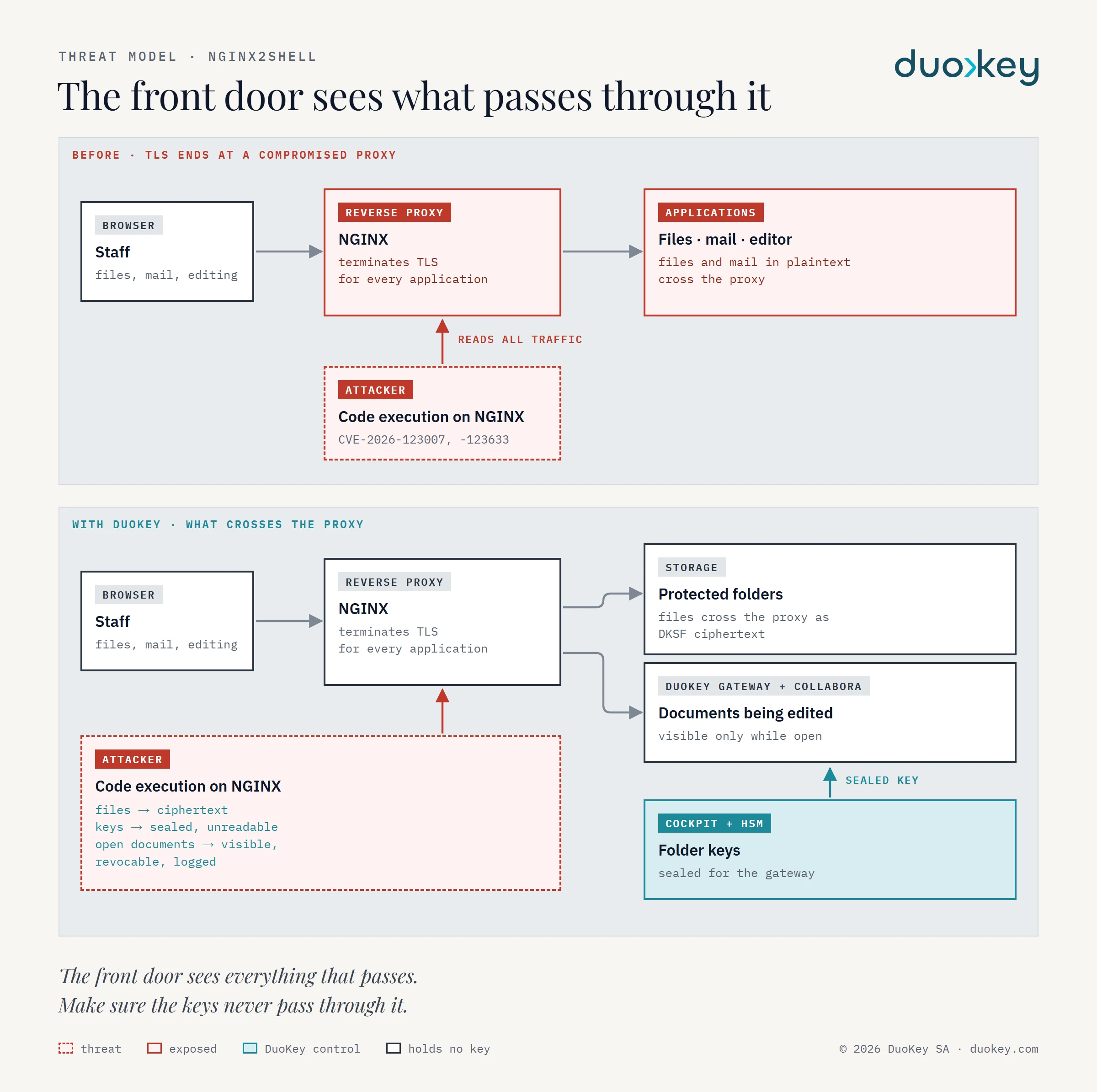
What a compromised proxy does not see with DuoKey
- Files in protected folders. With SecureFolder and Secure OpenCloud, they are stored on the platform as DKSF ciphertext. Sync, download and sharing carry exactly that ciphertext: the proxy sees unreadable data.
- The keys. Folder keys go from the DuoKey Cockpit to the gateway sealed with hybrid P-256 and ML-KEM-768. Even if that connection runs through the same proxy, it cannot open the key. The master key never leaves the HSM.
- Stored mailboxes. With Secure Open-Xchange, mailboxes are stored encrypted.
What it does see, we say plainly: documents opened in the editor during the compromise, and emails read in the webmail during that time. That is what the journal is for: it shows which folder keys were released to whom and when, and a revocation in the Cockpit takes effect at the next request. The damage stays limited and traceable, instead of covering the whole store.
Checklist for the coming days
- Update NGINX to 1.30.7 or 1.31.9, and NGINX Plus to the vendor's builds. Restart the service rather than only reloading it: on reload, the old master process keeps running [2].
- Until then, disable HTTP/2 (
http2 off; from NGINX 1.25.1, otherwise remove http2 from the listen directive). Note that this does not protect against the other NGINX flaws fixed in the same release [3].
- Find embedded NGINX: container images, OpenResty, ingress controllers, appliances. If you run kubernetes/ingress-nginx, you need a migration plan.
- Rotate session secrets and force new logins if a proxy may have been affected.
- Separate the proxy in front of the gateway and Collabora from the one in front of the rest of the platform, so one flaw does not reach everything at once.
- Find out which documents travel in plaintext on your servers and through your proxy today, and take the keys of the confidential ones out.
For the last point, test Secure OpenCloud, SecureFolder or Secure Open-Xchange with us in your own environment.
Sources
- JFrog Security Research, Nginx2Shell: All You Need to Know About CVE-2026-123007 and CVE-2026-123633, 18 November 2026. research.jfrog.com
- Previdian, Remote code execution in NGINX HTTP/2 (CVE-2026-123633, CVE-2026-123007), 18 November 2026. nginx2shell.com
- nginx.org, nginx security advisories. nginx.org