A building department works with an architect on a new school, a city prepares a council proposal with several offices, a region collects the files of a tender. Such projects live in shared storage, and OpenCloud is a lean, open-source platform with project spaces for them. As soon as citizen data, HR records or companies' bids sit in it, the usual question comes up: who can read them?
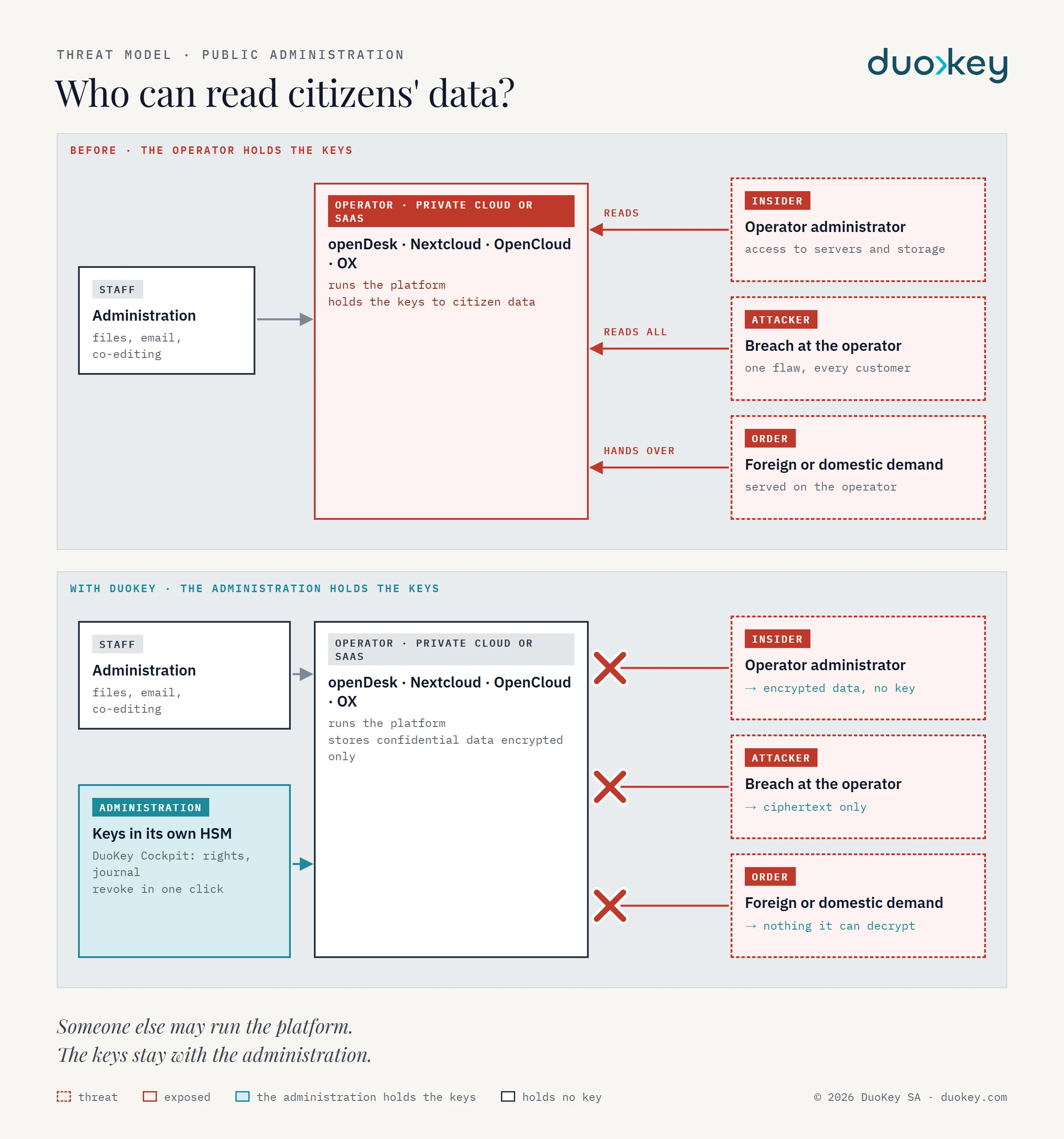
Whether OpenCloud runs in your data centre or at an IT provider, whoever runs the platform can reach the stored files. In daily life that is rarely a problem, but that is exactly what data protection reviews are for. An administrator with overly broad rights, a compromised server or an order served on the provider is enough.
How DuoKey Secure OpenCloud works, simply explained
- A protected project space. Documents in it are stored in OpenCloud encrypted only.
- The key stays with you. It sits in the administration's HSM or vault; the DuoKey Cockpit decides who may use it.
- Work together. Staff choose "Open with DuoKey" and co-edit the document in Collabora Online, several people at once. Decryption happens only while editing, in memory.
Two independent checks protect every document: OpenCloud checks membership of the project space, the Cockpit checks the right to the key. If either is missing, the document stays closed.
What it means for your obligations
- Appropriate security. GDPR Article 32 names encryption explicitly; the Swiss FADP requires data security appropriate to the risk in Article 8.
- Providers. If someone runs OpenCloud for you, you remain responsible (GDPR Art. 28, FADP Art. 9). A provider without the key is a much smaller risk in that assessment.
- Data breaches. If the data was encrypted and the key was not affected, notifying the people concerned can be waived under GDPR Article 34(3).
- Official secrecy and tender files. An operator without the key learns nothing about the content.
- Evidence. Every key release is in the Cockpit's access journal: who, when, which space.
No product makes an administration compliant on its own. Secure OpenCloud gives you a measure you can evidence in your data protection impact assessment.
The limits, stated plainly
Co-editing in one session works in project spaces; with individual shares, sender and recipient open separate sessions. File names, sizes and shares remain visible to OpenCloud, and previews and full-text search are not available in protected spaces. The availability of your keys belongs in your contingency planning.
Test it
You run OpenCloud or plan to? Test DuoKey Secure OpenCloud with us in your own environment, on one project space with your keys.
Sources
- General Data Protection Regulation (EU) 2016/679, Articles 28, 32 and 34. eur-lex.europa.eu
- Swiss Federal Act on Data Protection (FADP), Articles 8 and 9. fedlex.admin.ch