openDesk brings files, email, calendar, video calls and co-editing together in one sovereign workplace. Hardly any municipality runs all of that itself: openDesk comes as a provider's service or from the private cloud of a public IT provider. That is sensible. But it shifts a question every data protection officer asks: if someone else runs the workplace, who can read citizens' data?
Running is not the same as accessing
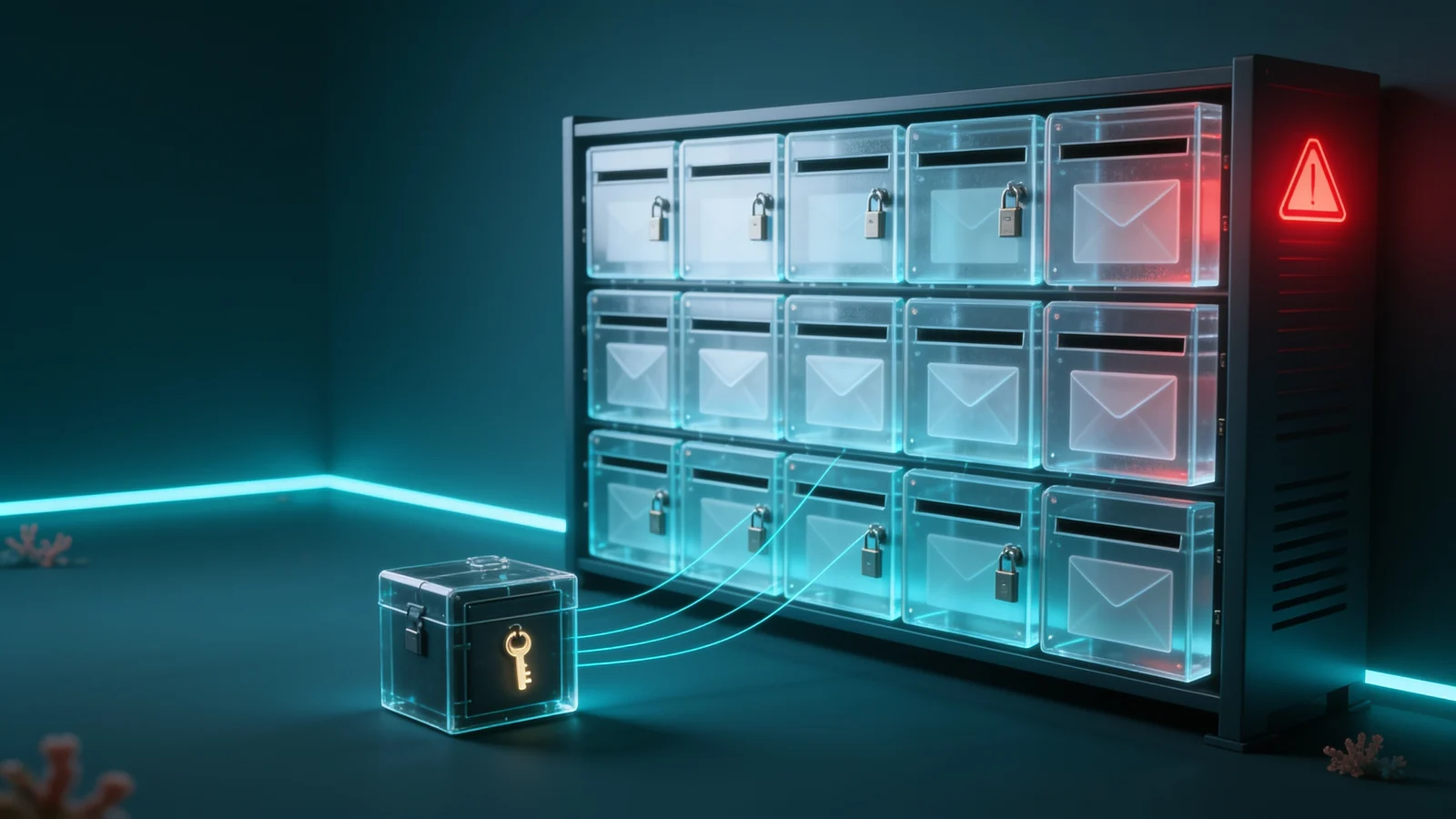
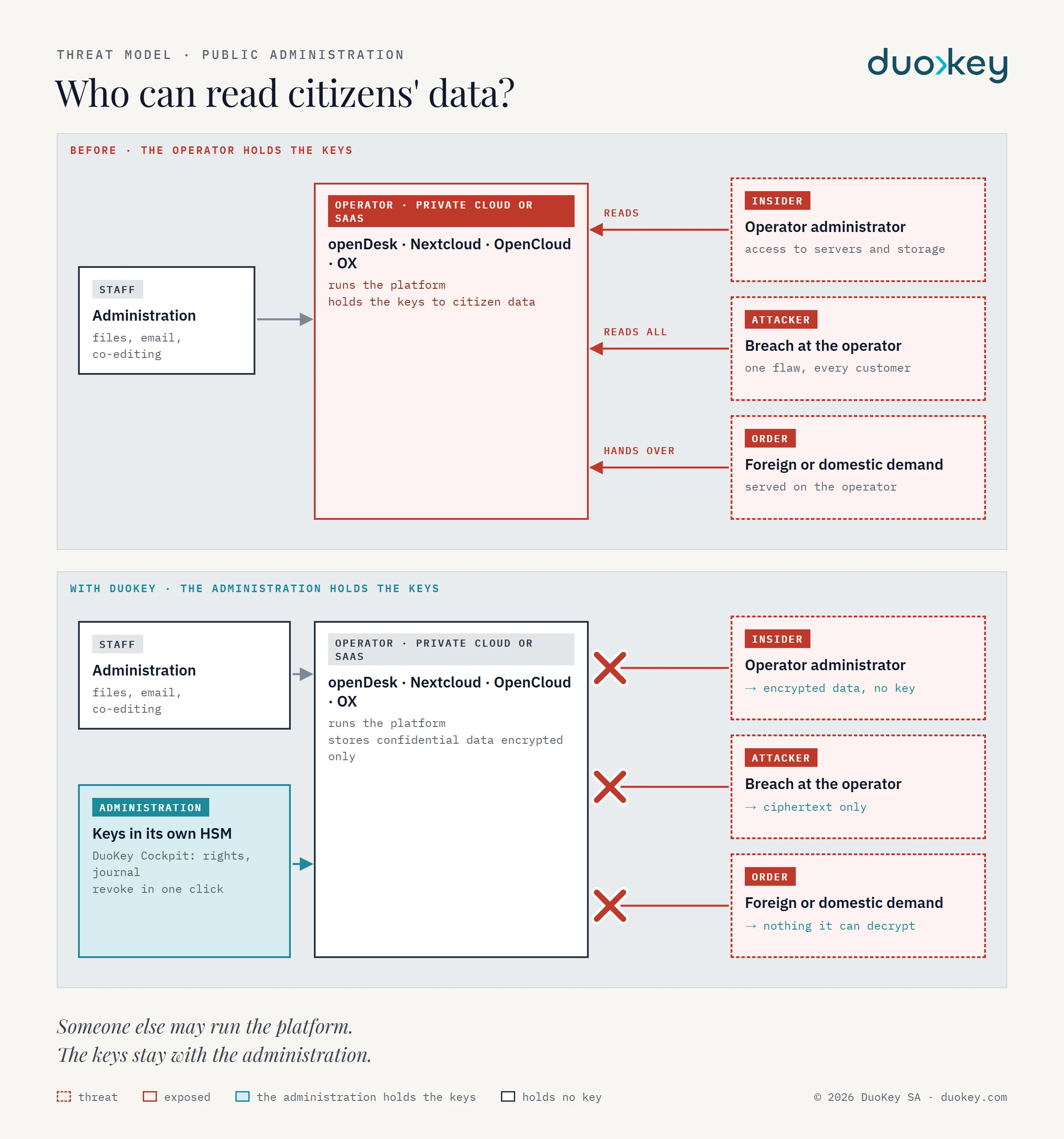
Whoever runs openDesk has access to the servers, databases and storage. Without an extra measure, the keys that protect files and mailboxes are there too. The operator can therefore read technically, even if the contract forbids it. The same goes for an attacker who breaks into its systems, and for an order addressed to it.
The answer is to separate running from accessing: the provider runs the platform, the administration holds the keys.
What DuoKey protects in openDesk
- Documents. With DuoKey SecureFolder, confidential folders in openDesk's file storage are encrypted only. Staff still open and co-edit them in the browser with Collabora Online.
- Email. With DuoKey Secure Open-Xchange, the email keys come from the DuoKey Cockpit: the OX Guard master key, the S/MIME keys and one key per mailbox.
- One place for all keys. The DuoKey Cockpit manages rights and logs every release; the master key sits in the administration's HSM or vault.
What it means for your obligations
- Responsibility stays with you. An administration that buys openDesk remains responsible for citizen data and must choose a provider with sufficient guarantees (GDPR Art. 28, FADP Art. 9). A provider that cannot read the data is a much smaller risk in that assessment.
- Appropriate security. GDPR Article 32 names encryption explicitly; the Swiss FADP requires data security appropriate to the risk in Article 8.
- Data breaches. If the affected data was encrypted and the key was not affected, notifying the people concerned can be waived under GDPR Article 34(3).
- Official secrecy and outside access. A provider without the key can neither accidentally nor on order hand over content it cannot read.
- NIS2. For administrations in scope, cryptography and supply chain security are among the required measures.
No product makes an administration compliant on its own. DuoKey gives you a measure you can evidence: keys with you, a journal in the Cockpit.
Three operating models
- Self-run. openDesk, Cockpit and HSM in your data centre.
- Hybrid. A provider runs openDesk; the HSM and the editing zone, where documents are briefly decrypted, stay with you.
- As a service. A variant with the editing zone in an isolated, attestable hardware enclave is in preparation.
The limits, stated plainly
File names, sizes and shares remain visible to the platform, as do email senders, recipients and subjects. Previews and full-text search are not available in protected folders. And the availability of your keys belongs in your contingency planning.
Test it
We are happy to work out with you and your openDesk provider which operating model fits, and to set up a first protected area with your keys. More on DuoKey SecureFolder and DuoKey Secure Open-Xchange.
Sources
- General Data Protection Regulation (EU) 2016/679, Articles 28, 32 and 34. eur-lex.europa.eu
- Swiss Federal Act on Data Protection (FADP), Articles 8 and 9. fedlex.admin.ch
- Directive (EU) 2022/2555 (NIS2). eur-lex.europa.eu